
Feature
CHANTS - an interview with Lucy_Unleashed
Miguel Vanzeler spent three years in Gaerea before leaving in 2022. CHANTS is what came next — a Portuguese black metal trio built around hi…
Constance Wibmer · 27 November 2026
There is a certain kind of English landscape that black metal rarely bothers with. Not the jagged fjords and permafrost that the genre's founding fathers made their own, but the we…
Rick Eaglestone·3 November 2026·9 min read
There is a certain kind of English landscape that black metal rarely bothers with. Not the jagged fjords and permafrost that the genre's founding fathers made their own, but the wet green hush of old woodland: moss on fallen trunks, roots splitting stone, the smell of rain hitting dry earth after weeks of waiting. It is quieter than a Norwegian mountainside, but no less ancient, and no less indifferent to the people walking through it. Manchester's Oakenthrone have built their entire identity around that indifference, and on debut full-length Ad Silvam ("To the Forest"), they make a compelling case that the woods have just as much to say about death as the frozen north ever did.
Oakenthrone's rise has been quick, but it has not been careless. What began in 2022 as the solo vehicle of Simon Nagington spent its first few years doing things the old-fashioned way: cassettes, word of mouth and a slowly building cult following. Embers of Reverie (2024) and Astral Binding & The Oathsworn (2025) both sold out, the latter climbing to the top of Bandcamp's UK black metal page, while a festival-exclusive split with Gate Master and the Paths Once Trodden (2024-2025) release through Darkwoods Records kept the name circulating among the faithful. The name nods loosely to Yggdrasil, the world tree, and Nagington has since spoken of it as a throne humanity may occupy for a while before nature claims it back. Then came the moment that changes every bedroom project: in 2025 Nagington recruited Nathan Caven (ex-Sathamel) on guitar, Ant Hurlock (ex-Mairu) on bass and Andrew Hunt (ex-Pist) on drums, turning a private vision into a working four-piece. A live debut at Manchester's Call of the Crow festival followed in October 2025, and by March of this year they were out on the road with Saor across the UK. The question facing Ad Silvam, then, is whether the expanded line-up has sharpened that vision or diluted it.
Happily, it is very much the former. Nagington spent the best part of a year writing these seven tracks before taking them to the full band, and you can hear both halves of that process in the finished record. The bones are unmistakably one man's, built on a worldview in which nothing lasts: gods rot on their mountaintops, men chase permanence and find only the grave, and the ground waits patiently for all of them. But the flesh on those bones belongs to a band, and the record breathes in a way that cassette-era Oakenthrone, for all its promise, never quite did.
It is worth pausing on just how crowded the field Oakenthrone are stepping into has become. British black metal has rarely been in better shape, and a band leaning on heritage, landscape and myth is no longer a novelty but something closer to a tradition of its own. Standing out takes songs and conviction. The encouraging thing about Ad Silvam is that it never sounds like a band trying to fit in. It sounds like a band that has thought long and hard about what it wants to say and has refused to rush the saying of it.
"Awacen" opens proceedings as a scene-setter, its title the Old English for "awoken", and it does exactly what an intro should: it sets the mood, it gets out of the way, and it hands over cleanly to the first real statement of the album. That statement is "A Vigil Under Sol", and it is a superb calling card. Nagington has described it as a conceptual piece about a mortal man discovering a decaying god, a sacrifice on a high peak offered in the hope of renewing something divine that is already crumbling back into the earth. That is a big idea for a song to carry, and the band meet it head on. It builds with real ceremony, carried by long, ascending melodic lines that feel like a climb towards a summit, and an underlying sadness that never lets the grandeur tip into bombast. It is easy to see why it was picked as a single.
The accompanying video, directed by Smara Kand, who also made the bands earlier "Embers Of Reverie" video, leans fully into that imagery, and it is worth seeking out as a companion piece. But the song stands perfectly well on its own. Its slow-building final stretch, in particular, has the kind of patience that only comes from a writer who trusts his material, letting the melody repeat and swell until it feels less like a riff and more like a ritual.
"Runic Mastery" is where the record bares its teeth, and it is a fitting title for a band whose name first grew out of Odin hanging from the world tree in search of the runes. Nagington's delivery takes on a raw, lacerating edge that sounds torn rather than performed, and the song refuses to settle into one gear, dragging its heels one moment and charging the next, without ever losing its footing. The Scandinavian influences that Nagington has never hidden, Windir and Moonsorrow chief among them, are most audible here, but they are filtered through something distinctly British: a little rougher, a little muddier, and all the better for it.
"Monolith" was the first taste of the album, and at nearly eight minutes it is the record's centrepiece in more ways than one. Nagington has framed it around "the magnitude of death" and the terror of "the post-mortem abyss", while also suggesting that the only true immortality lies in the memories of those left behind. It is the most crushing song here, built on riffs that live up to the title, slabs of sound that feel hewn rather than played, but there is a strange tenderness at its heart too. It never wallows. It looks into the void, acknowledges how vast it is, and then finds something worth holding onto anyway. As a lead single it was a statement of confidence. In the context of the full album, it is the axis everything else turns on. "Augur of Petrichor" takes its name from the scent of rain on parched ground, and it is one of the album's most evocative moments. An augur reads omens, so the title alone conjures someone sniffing the air for signs of what is coming, and musically it feels like weather rolling in over a valley: a gathering pressure, then the release. It is the track where the atmospheric and aggressive sides of Oakenthrone sit most comfortably together.
"Hiraeth" is the record's emotional curveball. The Welsh word has no tidy English equivalent, describing a deep, aching longing for a home that may no longer exist, or perhaps never did, and the song wears that melancholy openly. Reaching for a Welsh word rather than a Norse or Old English one is a telling choice in itself, pulling the record's gaze back towards the hills of these islands, and that subtle shift in perspective gives the back half of the album a welcome change of texture. It is the most reflective thing here, and arguably the most affecting.
Closing track "Et Sic Ad Silvam" ("And So, to the Forest") brings the journey full circle, letting a folk sensibility seep in at the edges to deliver a finale that feels less like an ending than a return. After everything that has come before, the album simply walks back into the trees, and it is hard to think of a more fitting conclusion for a record so preoccupied with everything eventually going back to the earth. It is expansive, unhurried, and quietly beautiful. Taken as a whole, the sequencing deserves real credit. Seven tracks is a lean running order for a genre that so often mistakes length for depth, and there is no sense of anything being padded or included out of obligation. The album rises, peaks with "Monolith", turns inward with "Augur of Petrichor" and "Hiraeth", and then lets go. Each song feels like a chapter in the same story rather than a standalone single bolted onto its neighbours, and the result is a record that genuinely rewards being heard in one sitting, late at night, lights off.
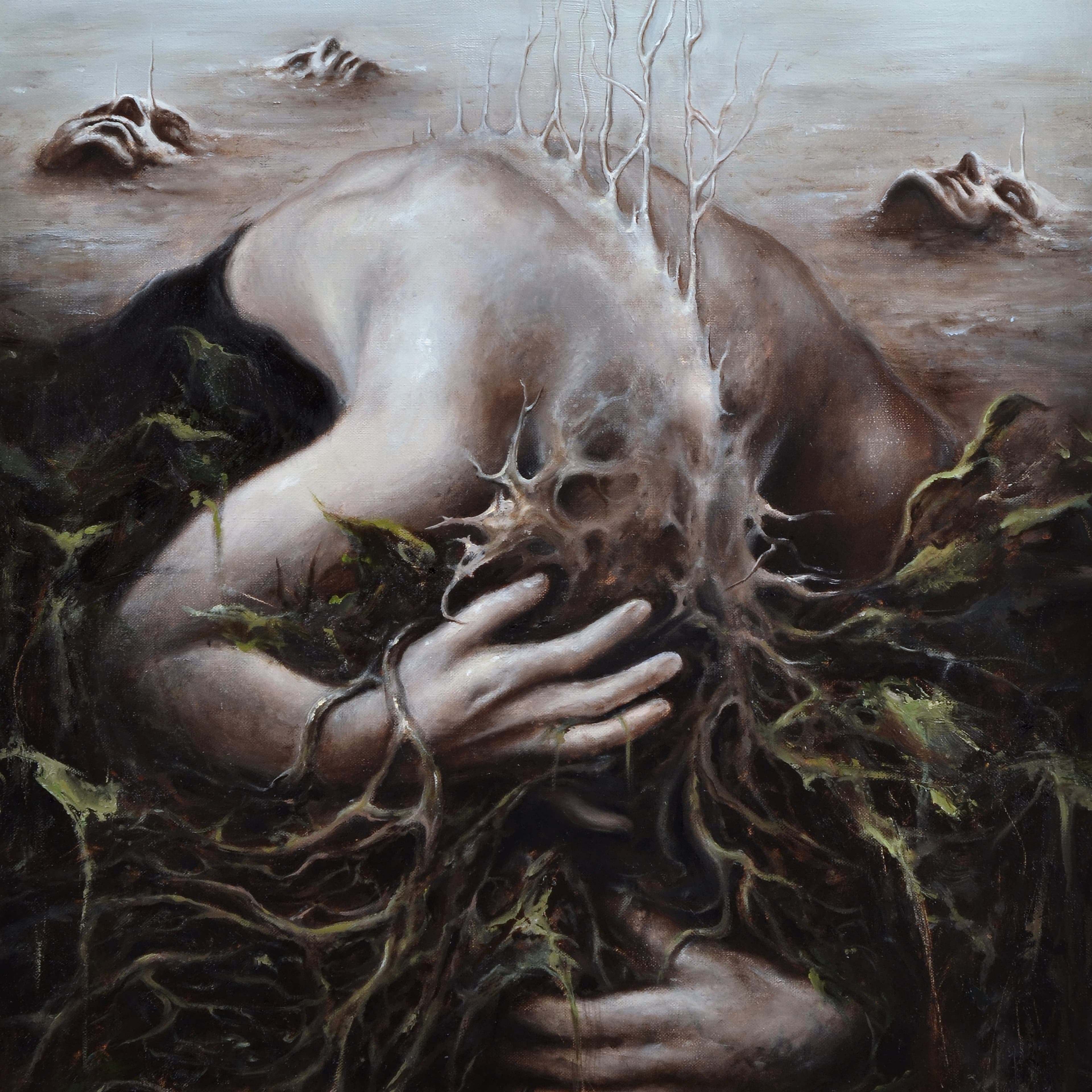
The band recorded the album themselves, with Caven and Nagington handling engineering duties, before handing it to Samuel Turbitt at Ritual Studios for mixing and mastering in the spring. Turbitt's work with The Infernal Sea, Trivax and Wolvencrown made him a sensible choice, and he has struck exactly the right balance. Ad Silvam is weighty without being suffocating; the guitars have room to shimmer, Hurlock's bass gives the heavier passages a genuine undertow, and Hunt's drumming is allowed to be both powerful and nuanced rather than reduced to a wall of triggered noise. The keys are used sparingly and tastefully, adding colour and depth rather than smothering everything in synthetic mist. Too many atmospheric black metal records confuse murk with mood; this one understands the difference. A word, too, for the artwork. Simon Chognot, whose previous work includes covers for Cepheide, Khôra and Moss Upon The Skull, has delivered an original oil painting that would look equally at home on a gallery wall. It suits the music perfectly, and it fits neatly with Nagington's long-stated admiration for Gustave Doré, John Martin and John Constable. This is an album that thinks in images, and it is a pleasure to see that reflected in the packaging rather than treated as an afterthought.
Perhaps the most impressive thing about the record, though, is how complete the band sounds. Debuts from former solo projects often betray the join, with hired hands dutifully playing parts written for them in isolation. That is not the case here. Caven's second guitar adds harmonic depth and a welcome bite to the faster sections, the rhythm section locks together with the kind of instinct usually earned over years rather than months, and Nagington himself sounds liberated by having a full band at his back, freer to push his vocals to the edge knowing the music beneath him will hold. Those first months on stage, the dates alongside Saor among them, have clearly done their work. This is a unit, not a mastermind and a backing band.
If there is a criticism, it is that Oakenthrone are working in well-trodden territory. British black metal steeped in landscape and old myth has a long and distinguished history, and those who want black metal to reinvent itself with every release may find Ad Silvam a little too comfortable in its lineage. But that would be missing the point. Oakenthrone are not trying to tear the genre down; they are trying to find their own clearing within it, and they have done exactly that. There is a clarity of purpose here, a sense that every song belongs to the same story, that so many debuts simply lack.
Ad Silvam is a debut that sounds like the work of a band several records into their career. Bleak, beautiful and built with obvious care, it is a remarkably assured first full-length, and further proof that the UK black metal underground is in rude health. It may have taken four years and a handful of cassettes to get here, but the wait has been worth every minute. Head out into the woods, wait for the rain, and let it take you.
Feature
Miguel Vanzeler spent three years in Gaerea before leaving in 2022. CHANTS is what came next — a Portuguese black metal trio built around hi…
Constance Wibmer · 27 November 2026
Review
"The second death is the last time anybody utters your name, and Necronautical have made sure theirs will be spoken for a long time yet." Th…
Rick Eaglestone · 27 November 2026
Interview
x-Act: Before we even start with Thragedium, I have to confess something. Just before your show yesterday, I met Fernando Ribeiro. He greete…
Constance Wibmer · 24 November 2026